Logo
← Back

Empathy Engine · Selfwear · Generative Commerce · Catalog Engine · System Architecture · UX Design · Creative Direction · Patent

Selfwear · 2025–present

Selfwear

Empathy Engine for Selfwear: clothing made with you, not pulled from stock. A system that reads taste – generative for one-off pieces and, in testing, as an engine for existing brand catalogs. Co-inventor of the underlying manufacturing patent.

View project
01

Initial Situation / Problem

Fashion has run in the same order for a hundred years: make first, sell later, write off the rest. E-commerce didn't change that – it is a shelf with a search bar. The best a recommender can do is push the closest match in stock to the front. If your piece doesn't exist, you get the next best thing – and the return that comes with it.

Selfwear flips the order: "Sell first. Then make. Or never make." Clothing that comes into being with a person – from their taste, their body, their hesitation – and is only produced once it's paid for. For the brand: no inventory risk, no markdowns, no structural returns. For the customer: a piece that adapts to them, not the other way round.

The road there runs at two speeds. The full vision – generating instead of choosing – needs on-demand manufacturing. But the same engine can already do something else today: read an existing catalog as if it were made for one person. That is where the work with brands begins.

Role

System Architect · Head of Product Sales Engine · Creative Director · Patent Co-Inventor (25%)

02

My Role / Contribution

System Architect & Head of Product Sales Engine (with William Lyons) – an active, ongoing role in the core team around CEO Max Bock, and co-inventor (25%) of the underlying patent application at the German Patent and Trade Mark Office:

Manufacturing method for individually definable and individually producible products — DPMA file no. 10 2026 103 667.8, ref. EEK-01/25-DE. Four inventors: William Lyons, Maximilian Bock, Luis Negron van Grieken, Charles Greene.

Contributions in detail:
  • Empathy Engine — concept and architecture: author of the system paper The Empathic Sales Engine and of the split between Perceiver (the interface that observes) and Interpreter (the modules that understand)
  • Selfwear — category and language: co-developing Selfwear as a product category and brand narrative – from the manifesto to the rhetoric of Inventory → Identity
  • Catalog engine: architecture decision and implementation of catalog mode – color and shape as separate blocks instead of one blended similarity (see below)
  • UX & MVP: carousel mode + vertical feed, six distinct engagement signals, convergence tracking, local-first
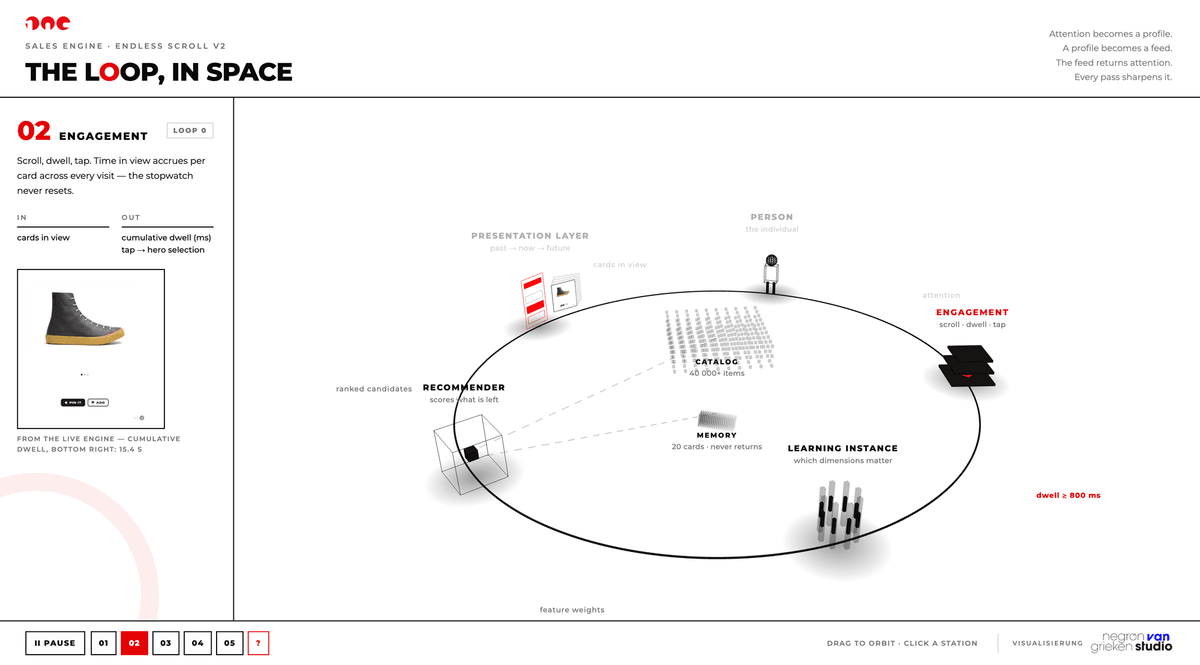
  • Visualization: The Loop, in Space – a 3D model of the recommendation loop as a thinking and communication tool for team, investors and brands

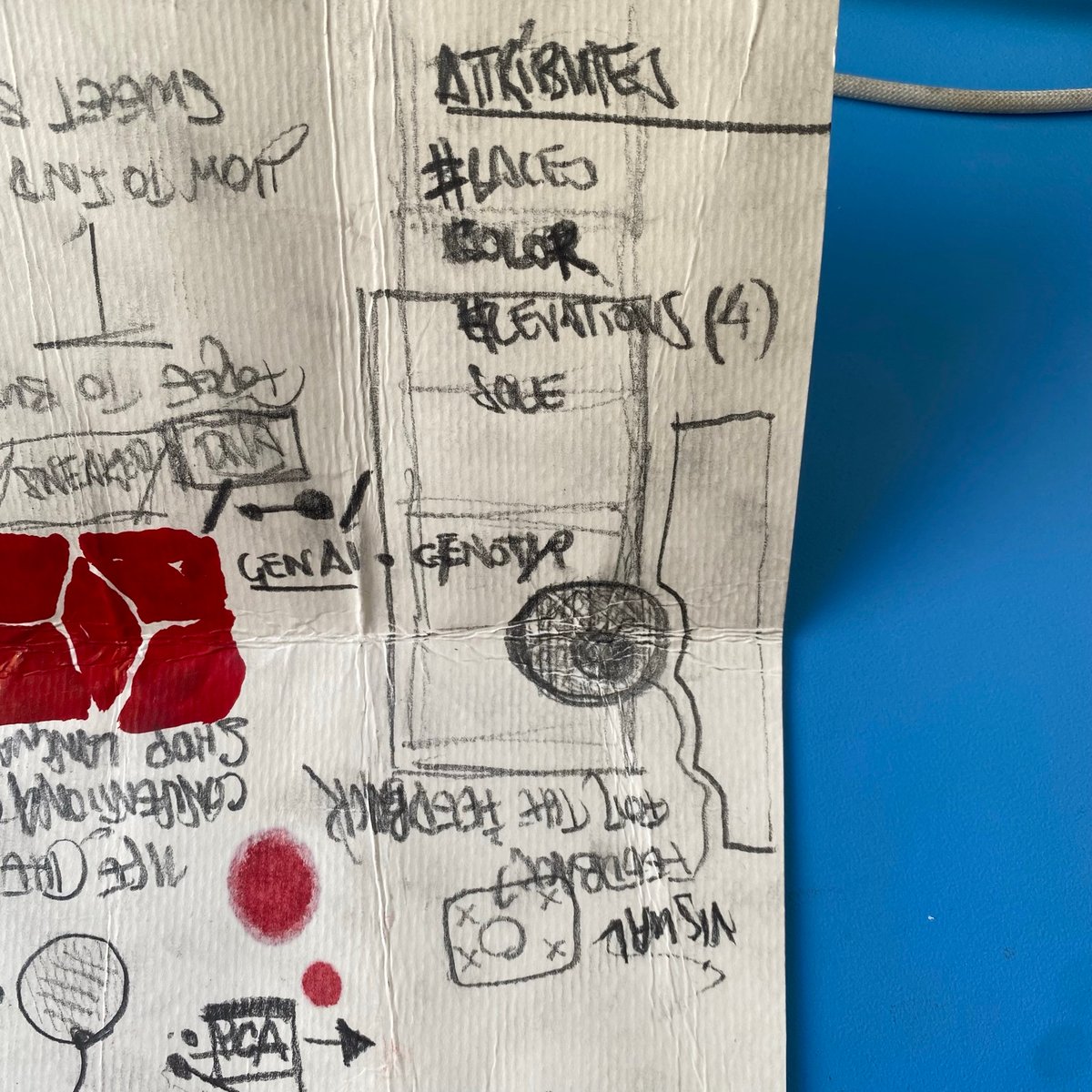
Early concept sketch: attribute system (laces, color, elevations, sole), GenAI/genotype note and PCA — the origin of Parameter Flow From paper sketch to system: color, shape and body identity and the PCA approach were on the table from day one – in catalog mode they are now production code.

03

Solution / Result

One engine that reads taste – two ways of answering it.

The core: Empathy Engine
  • Parameter Flow instead of a profile — a living description of taste: color identity (distribution across color families with learning rate and decay), shape identity (structural dimensions with mean and variance – variance reveals what really matters), body identity (geometry from a few smartphone photos)
  • Six engagement signals instead of a binary click: impression, quality impression (1.5 s dwell), click, hero selection, dismissal, revisit – pauses, hesitation and rejection all count
  • Convergence tracking — after stable cycles the system shifts from exploring what might resonate to showing what it knows
  • Local-first & privacy by design — the most intimate map of someone's taste stays on their device

“The Loop, in Space” — 3D visualization of the convergence loop: catalog, recommender, memory, learning instance and engagement as one closed cycle

Mode 1 — Selfwear: generate instead of choose

  • Co-creation inside the brand's codes: its materials, its taste, its promise – directed at one person
  • Parameters from browsing + geometry from the scan = a Generative Brief. On hero selection the brief freezes and becomes a production order
  • A flexible production cell builds exactly one piece – paid for before it exists. No SKU, no stock, no batch

Mode 2 — Catalog engine: existing stock, read as if made for one (in testing)
  • The same engine on a real brand catalog: a pilot with the range of a European fair-fashion label, 2,493 items
  • AI-assisted feature extraction from product images and data – every item becomes a point in color and shape space
  • Color and shape measured separately (named-block PCA: 6D shape block + 2D color block) instead of blended into one number that was secretly almost all color. Result: the silhouette share of the signal rose from 7.8% to 37.2%, and the quarter of the catalog that used to score as "equally poor matches" for varied taste is fixed
  • A product rule follows: color may cross categories (shoe and shirt in the same terracotta), shape stays within its family – no "chunky shoe → chunky coat"
  • New product lines (e.g. sneakers) only need a re-fit of the shape block, not a new architecture
  • Still open: a qualitative feel test with real feeds before wider rollout

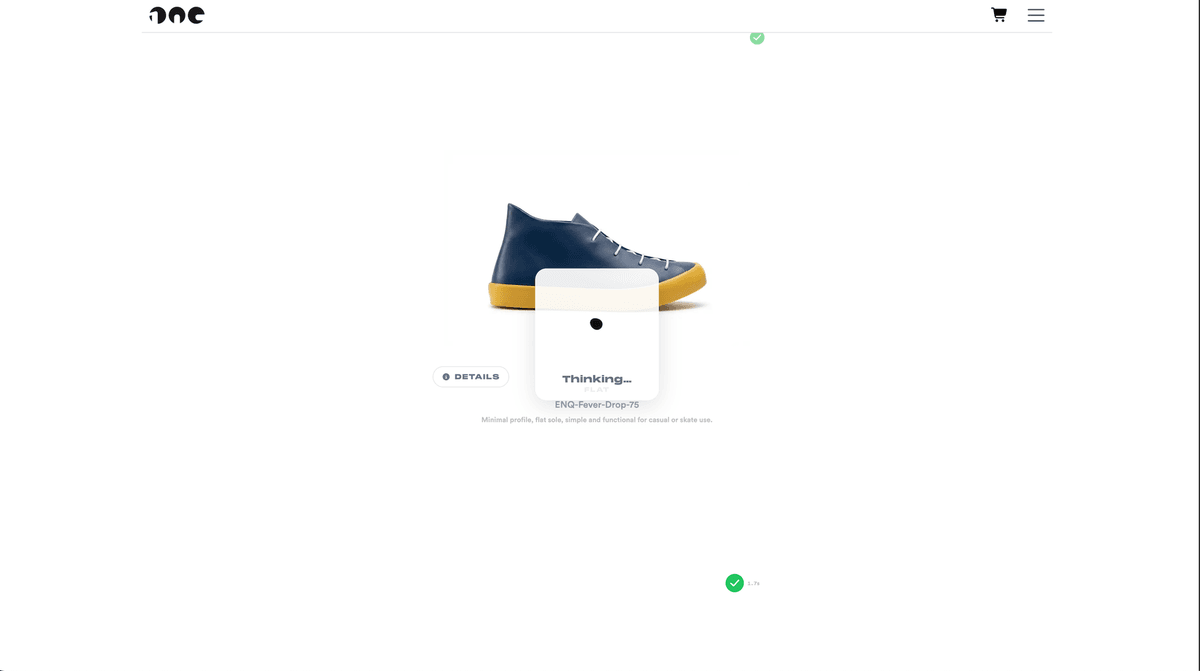
Live engine in the browser: generative “Thinking…” state during feature scoring, before the next card appears

04

Impact / Added Value

  • Patent application at the DPMA for the manufacturing method — the bridge from parameter to product legally protected
  • Working MVP of the Empathy Engine – carousel + vertical feed, six signal types, convergence logic, local persistence
  • Catalog mode in production code: computed and validated on 2,493 real items, demo-ready for brand pitches – not yet in live rollout
  • An entry point for brands before the factory exists: the catalog engine makes the empathy logic usable today and prepares the step to made for one – the same parameters that sort today become tomorrow's brief
  • Groundwork for second-order personalization: because color and shape are separate, the system can tell whether someone chooses "color-first" or "shape-first"
  • Selfwear as a category: Inventory → Identity, Overproduction → Intention, Made for many → Made for one – language that carries from the patent to the website
  • Ongoing engagement, not a closed commission: operational role in the Sales Engine team since 2025, with patent co-inventorship (25%)

Date

2025–present

Role

System Architect · Head of Product Sales Engine · Creative Director · Patent Co-Inventor (25%)

Skills

Empathy Engine · Parameter Flow · Convergence Tracking · Generative Brief · Named-Block PCA · Pipelines · React · Local-First Architecture · UX Design · Design Systems · Brand Development · Visual Systems · Cross-Media · Motion Design · Filmmaking · Copy & Communication

Next step

Visit project
Selfwear.

↗
← Back to work